
Are Your Blinds Safe? Canada's Cord Rules, Explained

Andor's Blinds

Window-covering cords are one of the most overlooked safety hazards in a home. They're easy to stop noticing — they've always just been there — but for a small child or a curious pet, a dangling or looped cord is a genuine strangulation risk. It's a serious enough concern that Canada changed the rules on what can be sold.
This article explains, in plain language, what those rules mean, how to check whether the blinds you already have are a risk, and what your safest options are. It is general guidance, not legal advice — for the official details, always refer to Health Canada.
Why blind cords are a safety concern
Young children are drawn to cords, and they don't recognize danger. A loose pull cord, or a looped cord on the side or back of a blind, can wrap around a small neck in seconds, often silently. Cribs, beds, change tables, sofas, and play areas placed near a corded window are the highest-risk spots, because they give a child a way to reach the cord. Pets — especially cats and small dogs — can get tangled too.
The reassuring part: this is a very preventable hazard. Modern cordless and motorized designs remove the risk entirely, and there are simple steps you can take even before you replace anything.
What Canada's cord rules require
To reduce these incidents, Health Canada introduced the Corded Window Coverings Regulations, which apply to window coverings sold in Canada (in force since 2022). In broad terms, the rules require that window coverings sold today either have no cords, or have cords that don't pose a strangulation hazard.
In practical terms, the regulations limit reachable cords to a maximum length of 22 centimetres, and require that any loop formed by reachable cords stays small enough not to fit over a child's head (an inner perimeter no greater than 44 centimetres). The goal is straightforward: no accessible cord long enough, or loop large enough, to wrap around a child's neck.
A couple of clarifications homeowners often ask about:
- The regulations apply to products sold going forward. Older blinds already installed in your home are not automatically illegal — but they may pre-date the new safety standard, which is exactly why it's worth checking them.
- For the precise legal requirements and the most current information, refer to Health Canada's official page on corded window coverings rather than relying on a summary like this one.
Important: This is general information. For the exact, current requirements, see Health Canada's official guidance, and ask us about the safety features of any specific product before you buy.
How to check whether your current blinds are a risk
A quick walk-through of your home will tell you a lot. In each room, look for:
- Blinds or shades with a looped pull cord or a continuous loop chain within a child's reach.
- Long, loose cords hanging down the side of a blind.
- Inner cords that can be pulled out into a loop (common on older horizontal blinds).
- Any corded window with a crib, bed, sofa, or climbable furniture positioned near it.
Pay closest attention to bedrooms, nurseries, and play areas. If you find a corded blind near where a child sleeps or plays, that's the first one to address.
The safest options today
When you're ready to upgrade — or outfitting a new room — these are the child-safe choices, from simplest to most advanced.
Cordless lift
A cordless blind or shade is raised and lowered by hand, with no operating cord at all. It's clean, simple, and removes the hazard entirely. For most rooms with children, this is the easy default.
Motorized
Motorized shades have no cords and are operated by a remote, wall switch, or phone app. Beyond safety, they're genuinely convenient for hard-to-reach or large windows, and they can be scheduled — useful for managing our intense Okanagan afternoon sun.
Wand-operated
Some window coverings tilt with a rigid wand rather than a cord, which avoids the looped-cord hazard entirely. If a room already has wand-operated coverings, they're a lower priority than anything corded. For new coverings, cordless and motorized are the two we'd point you to.
If you're not ready to replace everything yet
You don't have to redo the whole house at once. Sensible interim steps include:
- Move furniture away from corded windows — especially cribs and beds.
- Keep cords fully out of reach, and don't leave loose cords dangling where a child can grab them.
- Prioritize the highest-risk rooms first — nurseries and children's bedrooms — and upgrade those to cordless or motorized, then work through the rest over time.
Even small changes reduce risk while you plan the upgrades that matter most.
Mistakes to avoid
- Assuming older blinds are fine because "they came with the house." Many pre-date the current safety standard.
- Tucking a cord up high and considering it solved. Children climb, and cords slip down. Cordless removes the question entirely.
- Overlooking the back cords on older horizontal blinds, which can be pulled into a loop.
- Leaving the nursery for last. It's the room that matters most — start there.
Frequently asked questions
Are my older corded blinds illegal?
No. The regulations govern what can be sold, not what's already installed in your home. Older corded blinds aren't automatically prohibited — but because they may pre-date the current safety standard, they're worth checking and, ideally, upgrading in rooms used by children.
What are the safest blinds for a nursery?
Cordless or motorized shades, with no operating cord at all. A cordless blackout or cellular shade is a popular nursery choice because it's both safe and good for daytime naps during our long, bright summer days.
Do cordless blinds cost more than corded ones?
Sometimes a little, depending on the product, but the gap has narrowed a lot as cordless has become standard. For the peace of mind in a child's room, most parents find it well worth it.
Are motorized blinds a good safety option?
Yes — they have no cords and remove the hazard, and you get the convenience of remote or scheduled operation as a bonus. They're especially worth considering for high or hard-to-reach windows.
Want safer blinds for your family?
Book a free in-home consultation and we'll walk through your rooms, point out any corded hazards, and show you cordless and motorized options that fit your home and budget — with no pressure.
More articles
All articles
Best Blinds for Kelowna's Hot, Sunny Summers
Kelowna gets more sun than almost anywhere in Canada. Here are the blinds and shades that actually keep an Okanagan home cooler — and how to match them to each room.
Heat, UV & energy comfort
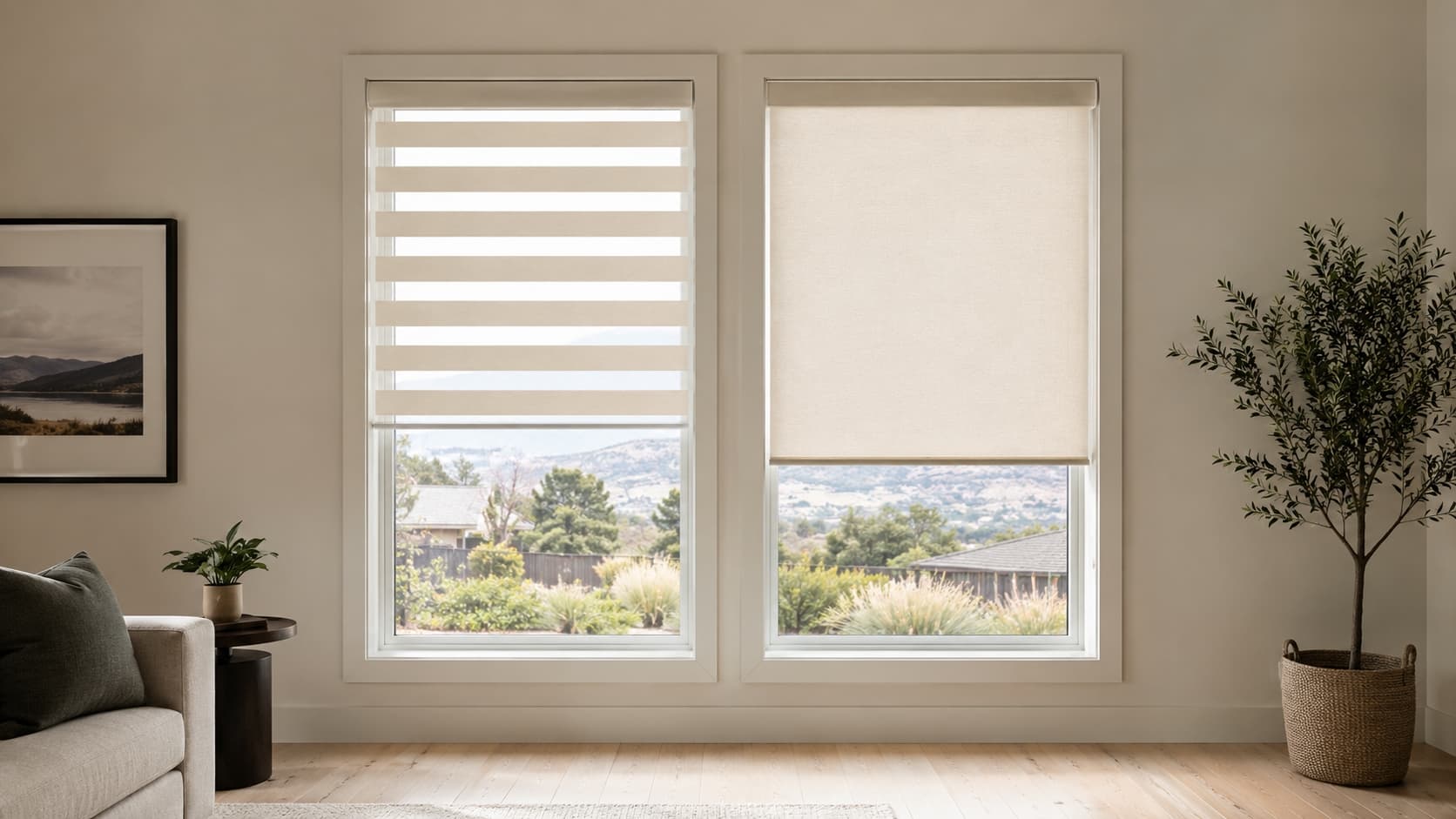
Zebra Blinds vs Roller Shades: Which Is Right for Your Home?
They look alike but solve different problems. A straight comparison of light control, privacy, cost, and looks to help you choose with confidence.
Product comparisons